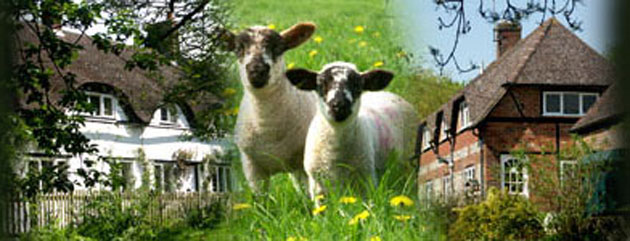
The Civil Parish of East Garston is a long narrow Parish of about 4,500 acres bordering South Fawley in the North and including Poughley in the South and bounded by Maidencourt and Coldborough farms to the East and West. The population has been fairly static for some years at around 550 people in 240 households.
A Brief History of the Parish
Evidence of human habitation in the East Garston area has been found dating back to prehistoric times, some thousands of years BC. There are Neolithic earthworks, ditches and enclosures to be seen, as well as pottery fragments and metalwork found that date back to the Bronze Age.
During Roman times, around 43 to 410 AD, local natives must have felt the very close presence of the occupying legions with Ermin Street, the Roman road that linked the important towns of Silchester and Cirencester, passing through the Southern end of the Parish by Woodlands St Mary and Poughley.
With the collapse of their Empire, the Romans left Britain in around 410. Next to invade were the Angles and Saxons, entering Berkshire via the Thames and from Southampton, and occupying the Berkshire Downs in about 560 AD with many Britons fleeing or being enslaved. There is little recorded history of this early Anglo Saxon period other than a book written by Gildas, a British monk, the title of which, “The Ruin of Britain”, sums up what he thought about it.
The Vikings were next to visit, and it was in 871 that a major battle was fought at nearby Ashdown, against the Scandinavian invaders. It was here that King Alfred the Great, who was born at Wantage, defeated the Vikings having travelled to Shefford and Eddington, passing close to East Garston, the day before the Battle. It is hard to believe that local inhabitants would not have been drawn in to fight for the local King Alfred.
During the time leading up to the Norman invasion 1066, a man named Asgar held the position of provider of horses to King Edward. As well as other land, he owned the Lambourn Hundred, an area of land which included a place known as Asgar’s tun, a tun being the Saxon name for a village. Over the years, the name Asgar’s tun suffered many variations, including Esgarston, before finally appearing as East Garston on a map in 1607, although that did not stop the Revd John Tudor leading a spirited campaign in 1904, to change the name back to Esgarston. Despite having failed to win the day, he continued to use his version of the name throughout his ministry as can be seen in the Church registers of the time.
After the Norman Conquest, Asgar’s land was taken from him and given to Geoffrey de Mandeville and shortly after, Asgar’s tun was listed in the Domesday Book with the following assessment of its value:
- 30 hides (a hide being the amount of land required to feed a family and its dependants)
- Land for 20 ploughs
- 2 Mills
- 5 acres of meadow
- Woodland for 40 pigs
- 23 villagers, 12 smallholders and 3 slaves!
- With a total value set at £20.
All Saints Church dates back to 1190, although, there may have been a previous Saxon church on the site. Some of the Norman architectural features still remain today, notably the doors in the North and South walls of the nave and South transept. The Church provides numerous other tangible links with history with a 1576 chalice, still used for special services, and historic registers of baptisms, deaths and marriages, one dating back to 1554. Even some of the yew trees in the churchyard are believed to be between 400 and 600 years old. It is fascinating to think that when that chalice was first used, when those early records were written, and possibly when some of the yew trees were young saplings, Queen Elizabeth 1 was on the throne, Shakespeare was writing his plays, and Sir Francis Drake was defeating the Spanish Armada.
Despite the Berkshire Downland being reserved for the Royal Chase with the area being regularly frequented by various kings’ hunting parties, the next few centuries were hard for ordinary people who suffered from famine, plague and war as the Crusades, followed by the Hundred Years War, drained the country’s wealth. The Black Death of 1349 alone killed about a third of the population and East Garston did not escape its grip.
The ownership of East Garston changed hands many times throughout the following centuries until, finally, in 1919, it was sold by the last Lord of the Manor, Sir Francis Burdett, and the properties went into private ownership.
As if any further evidence were needed that small, remote rural communities do not escape the impact of major world events, the War Memorial in East Garston village proudly displays the names of those who fell in the two World Wars and the roll is called annually on Remembrance Sunday.
Family History Research
The Parish Council often receives requests from visitors to this website for information regarding family history research. The Parish Council and indeed the Church do not hold copies of civil or parochial records (most of these are at the Berkshire Record Office) so we are often unable to help.
Where we can, we will reply to simple enquiries if there is any obvious family or location link but we do not have the resources to enter into extended research.
However, local resident Dave Knight has kindly offered assistance (d.knight636@btinternet.com) for areas in which he has gained knowledge. Dave has researched several aspects of local history and may be able to help point you in the right direction by offering contact details for Record Offices, libraries and other resources that he has found useful while undertaking his own research.
Discovering Our Parish
East Garston is at the heart of the North Wessex Downs Area of Outstanding Beauty and is a joy for exploring.
The AONB have produced this leaflet about the geology of the Parish and a walk to discover its beauty.
Aerial Video of the Village
An aerial view of our beautiful village courtesy of parishioner Colin de Fraine
Archive
For more than 7 years East Garston Parish Council supported the outstanding website east-garston.com. The site was created and maintained by the late Ken Tarbox and it became an enviable information source and social history archive for our community. Ken retired from the management of the site and the Parish Council had to rethink its approach to a web presence. This website is the result but we are pleased to say that none of the valuable archive will be lost. The archive aspects of east-garston.com can still be accessed thanks to the sponsorship of village resident James Pryer.